Pentapeptide-3 Powder: Mechanism, Benefits, Applications And Cosmetic Ingredient Guide
Sep 23, 2026
what is Pentapeptide-3 Powder?
Pentapeptide-3 powder is a short synthetic peptide consisting of five amino-acid residues. It is commonly identified by the sequence Gly-Pro-Arg-Pro-Ala-NH₂, abbreviated as GPRPA. Cosmetic ingredient literature commonly associates this peptide with the trade name Vialox and with neurotransmitter-inhibiting approaches to wrinkle care.
Unlike many popular anti-aging peptides that are positioned around collagen, extracellular matrix, or skin-barrier pathways, Pentapeptide-3 has been studied primarily for its interaction with acetylcholine receptor signaling.
A 2024 dermatology review lists Pentapeptide-3 among neurotransmitter inhibitor peptides and describes it as an acetylcholine receptor antagonist associated with anti-aging and wrinkle-reduction applications.
A 2025 scientific study further investigated Pentapeptide-3 using quantum-chemical calculations, molecular docking, molecular dynamics and ADME-related computational approaches. The study described the peptide as a competitive antagonist of acetylcholine receptors and investigated its potential relationship with muscle contraction and wrinkle appearance.
This makes Pentapeptide-3 particularly interesting for brands developing peptide-based anti-wrinkle and expression-line care products.
Pentapeptide-3 at a Glance:
| Property | Information |
|---|---|
| Product Name | Pentapeptide-3 |
| Peptide Sequence | Gly-Pro-Arg-Pro-Ala-NH₂ (GPRPA) |
| CAS No. | 135679-88-8 |
| Molecular Formula | C21H37N9O5 |
| Molecular Weight | 495.58g/mol |
| Peptide Type | Synthetic pentapeptide |
| Appearance | White to off-white powder |
| Typical Purity Specification | ≥98% by HPLC |
| Cosmetic Positioning | Anti-aging / expression-line care |
| Main Research Mechanism | Acetylcholine receptor-related activity |
| Typical Product Formats | Serums, creams, eye creams, masks and other leave-on formulations. |
How Does Pentapeptide-3 Work?
1. Interaction with acetylcholine receptor signaling
Acetylcholine is an important neurotransmitter involved in communication between nerves and muscles. Muscle contraction requires signaling through the neuromuscular junction. Nicotinic acetylcholine receptors are key components of this signaling process.
Pentapeptide-3 has been described in cosmetic-science literature as an acetylcholine receptor antagonist. The proposed mechanism involves competitive interaction with postsynaptic receptors, reducing the signaling associated with muscle contraction.
2. Relationship with facial expression lines
Repeated facial expressions can cause repeated folding of the skin. Over time, expression-related lines may become increasingly visible. Therefore, cosmetic ingredients that are investigated for their effects on neuromuscular signaling have attracted interest as an alternative approach to conventional anti-aging ingredients.
Pentapeptide-3 is positioned within this category of neurocosmetic peptides, where the formulation concept is related to reducing the appearance of expression-associated wrinkles rather than simply increasing skin hydration.
3. A different approach from collagen-supporting peptides
Not all peptides work through the same biological pathway. Some cosmetic peptides are investigated for extracellular matrix and collagen-related effects, while others are designed around neurotransmitter signaling. Pentapeptide-3 belongs to the latter category.
This distinction is particularly important when selecting peptide ingredients for a formulation because the desired product concept should determine which peptide system is appropriate.
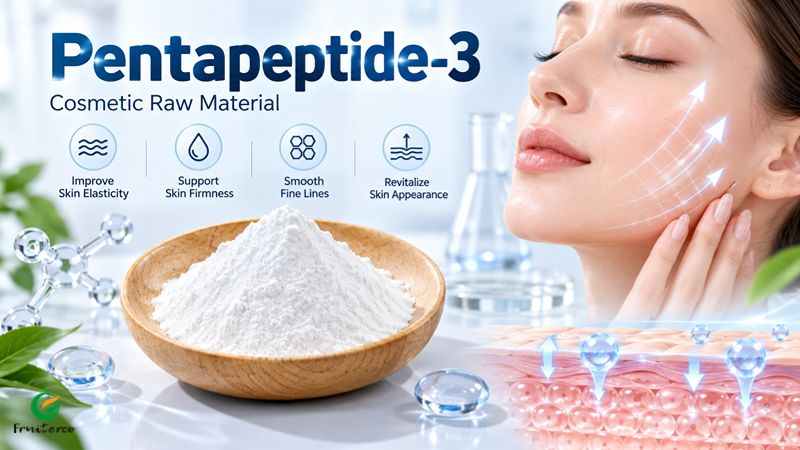
What Are the Benefits of Pentapeptide-3?
Pentapeptide-3 is primarily associated with the following cosmetic formulation concepts.
1. Expression-Line Care
Pentapeptide-3 is commonly positioned for products targeting the visible appearance of expression lines. This makes it relevant to facial areas where repetitive expression can contribute to visible lines, including the forehead and areas around the eyes.
2. Anti-Wrinkle Formulations
Cosmetic literature places Pentapeptide-3 within the anti-aging peptide category. A 2024 review lists it specifically under neurotransmitter inhibitor peptides and associates it with wrinkle reduction.
3. Fine-Line Care
Because expression-related muscle movement is one of the research targets of Pentapeptide-3, the ingredient can be incorporated into product concepts focused on the appearance of fine lines.
4. High-Performance Peptide Formulations
Pentapeptide-3 can also be used as one component of a broader peptide system. A modern anti-aging formulation may combine peptides with different functional targets, together with humectants, antioxidants, barrier-support ingredients and other cosmetic actives.
Pentapeptide-3 Cosmetic Applications:
1. Anti-Wrinkle Serums
Serums are one of the most suitable formats for communicating the functional positioning of peptide ingredients.
Pentapeptide-3 can be considered for advanced anti-aging serum concepts focused on:
- Expression-line care
- Fine-line appearance
- Mature-skin care
- Peptide-based skin care
- Advanced anti-aging formulations
A formulation may combine Pentapeptide-3 with other peptides and supporting ingredients to create a multi-functional anti-aging system.
2. Eye Creams
The eye area is a major focus of anti-aging skincare. Pentapeptide-3 can be considered for eye creams and eye serums designed around expression-line care, particularly when combined with moisturizing and skin-conditioning ingredients.
3. Anti-Aging Face Creams
Pentapeptide-3 can also be incorporated into facial creams intended for daily anti-aging routines. In this type of formulation, it may be combined with:
- Hyaluronic acid
- Ceramides
- Antioxidants
- Vitamin C derivatives
- Other cosmetic peptides
- Skin-conditioning agents
The exact compatibility, concentration and processing conditions should be established through formulation testing.
4. Facial Masks
Peptide-based facial masks provide another potential application area. Pentapeptide-3 may be included in premium anti-aging mask concepts where the product positioning emphasizes peptide technology and expression-line care.
5. Multi-Peptide Formulations
One of the most interesting applications for Pentapeptide-3 is its use as part of a multi-peptide system.
Different peptides may be selected for different formulation objectives. For example, a brand may develop a system combining:
Neurotransmitter-related peptides + matrix-support peptides + moisturizing ingredients + antioxidants
This allows formulators to create a broader anti-aging product concept rather than relying on a single active ingredient.

Pentapeptide-3 vs. Other Cosmetic Peptides:
It is important not to treat all anti-wrinkle peptides as interchangeable.
| Peptide | Main Cosmetic Research Direction |
|---|---|
| Pentapeptide-3 | Acetylcholine receptor-related / expression-line care |
| Pentapeptide-18 | Neurotransmitter-related signaling |
| Acetyl Hexapeptide-8 | SNARE complex / acetylcholine release |
| Tripeptide-3 (Syn-Ake) | Acetylcholine receptor-related activity |
| Palmitoyl Pentapeptide-4 | Extracellular matrix / collagen-related anti-aging research |
A 2024 dermatology review distinguishes these peptide classes according to their structures and proposed mechanisms. This distinction matters for both formulation development and product marketing.
Why Choose Pentapeptide-3 for Cosmetic Formulation?
Pentapeptide-3 provides formulators with a peptide option that is mechanistically different from many collagen-focused anti-aging ingredients.
Its key positioning can be summarized as:
Synthetic pentapeptide → acetylcholine receptor-related mechanism → neuromuscular signaling research → expression-line care → anti-aging formulation
This creates a clear ingredient story for premium skincare products. For B2B buyers, the ingredient can also be evaluated based on objective technical parameters rather than marketing claims alone.
The combination of a defined peptide sequence, analytical purity specifications and established cosmetic research makes Pentapeptide-3 a useful ingredient to consider during the development of peptide-based skincare systems.
Is Pentapeptide-3 the Same as Botulinum toxin?
No. Pentapeptide-3 is a peptide ingredient used in cosmetics, whereas botulinum toxin is a bioactive neurotoxin used in medical and aesthetic procedures. Therefore, Pentapeptide-3 should not be referred to as botulinum toxin, nor should it be marketed as an equivalent medical treatment. Pentapeptide-3, supplied as a cosmetic raw material, is not a finished pharmaceutical product.
Pentapeptide-3 FAQ:
Q1. What is Pentapeptide-3?
Pentapeptide-3 is a synthetic five-amino-acid peptide commonly identified as Gly-Pro-Arg-Pro-Ala-NH₂ (GPRPA). It is used in cosmetic ingredient research, particularly for anti-aging and expression-line care formulations.
Q2. What is the CAS number of Pentapeptide-3?
The commonly listed CAS number is 135679-88-8. Buyers should confirm the CAS and supplied molecular form against the batch-specific technical documentation.
Q3. What is the sequence of Pentapeptide-3?
The commonly reported sequence is Gly-Pro-Arg-Pro-Ala-NH₂ (GPRPA).
Q4. What is Pentapeptide-3 used for?
Pentapeptide-3 is mainly evaluated for cosmetic formulations targeting expression lines, fine lines and the appearance of wrinkles, particularly in anti-aging skincare products.
Q5. How does Pentapeptide-3 work?
Research describes Pentapeptide-3 as an acetylcholine receptor antagonist associated with postsynaptic neuromuscular signaling. The proposed cosmetic mechanism involves reducing signaling associated with muscle contraction.
Q6. Is Pentapeptide-3 suitable for serums?
Yes. Pentapeptide-3 can be considered for peptide-based anti-aging serums, subject to formulation compatibility and the supplier's recommended handling conditions.
Q7. Can Pentapeptide-3 be used in eye creams?
It can be considered for eye-care formulations targeting the appearance of expression-related lines. Final suitability depends on the complete formulation and product safety assessment.
Q8. Is Pentapeptide-3 the same as Palmitoyl Pentapeptide-4?
No. They are different peptide ingredients with different structures and research positioning. Pentapeptide-3 is commonly reported as GPRPA, while Palmitoyl Pentapeptide-4 belongs to a lipidated KTTKS-related peptide system.
Q9. Is Pentapeptide-3 the same as Pentapeptide-18?
No. Pentapeptide-18 and Pentapeptide-3 are different peptide sequences with different proposed mechanisms. Cosmetic peptide reviews classify them separately.
q10. What is the purity of Pentapeptide-3?
The Fruiterco product specification states ≥98% by HPLC. The actual specification for a purchased batch should always be confirmed through the corresponding COA.
Q11. What does Pentapeptide-3 look like?
It is commonly supplied as a white to off-white powder or lyophilized powder, depending on the supplied form.
Q12. How should Pentapeptide-3 be stored?
Storage conditions should follow the supplier's current TDS/SDS and batch documentation. Peptide raw materials are generally protected from excessive heat, moisture and light, with specific temperature requirements depending on the supplied form.
Q13. Can Pentapeptide-3 be combined with other peptides?
Pentapeptide-3 can be evaluated as part of a multi-peptide cosmetic system. Formulators should conduct compatibility and stability testing before commercial production.
Q14. Is Pentapeptide-3 a finished cosmetic product?
No. When supplied as a cosmetic raw material, Pentapeptide-3 is an ingredient/raw material intended for formulation development rather than a finished skincare product.
Q15. Where can I source Pentapeptide-3 in bulk?
B2B buyers should evaluate suppliers based on identity, HPLC purity, batch COA, SDS/TDS, packaging, storage conditions, minimum order quantity and international shipping capability. Our company offers high-quality Pentapeptide-3 with prompt delivery. Please send your requirements to our email at info@fruiterco.com, and our team will prepare and send you a quotation.
References:
1. Crous, L. et al. Overview of popular cosmeceuticals in dermatology. Skin Health and Disease, 2024.
2. Current Approaches in Cosmeceuticals: Peptides, Biotics and Marine Biopolymers. 2025.
3. Akhan, S. et al. Quantum Chemical, Spectroscopic and In Silico (Molecular Docking, Molecular Dynamic, ADME) Studies on Anti-Aging Pentapeptide-3 (Vialox). International Journal of Quantum Chemistry, 2025.
4. Akhan, S. et al. Integrative In Silico and In Vitro Evaluation of Vialox and Leuphasyl Pentapeptides for Antiaging Applications. Chemistry & Biodiversity, 2026.
5. Aung, et al. NoTox Tweakments: Evidence for Topical Neurocosmetic Peptides as Needle-Free Neuromodulators for Facial Wrinkle Reduction-A Systematic Review. Journal of Cosmetic Dermatology, 2026.
6. El Hadmed, H. & Castillo, R. F. Cosmeceuticals: peptides, proteins, and growth factors. Journal of Cosmetic Dermatology, 2016.