Patchouli Extract: Active Ingredients, Scientific Basis, Benefits, Uses, And FAQs
Sep 21, 2026
what is Patchouli Extract?
Patchouli extract is primarily derived from Pogostemon cablin. Patchouli is a perennial aromatic herb native to South and Southeast Asia and is currently cultivated in various tropical and subtropical regions.
Patchouli has a long history of traditional use. In traditional herbal practice, it is frequently employed in formulations addressing digestive discomfort, nausea, headaches, and the common cold. Modern research has increasingly focused on its phytochemical constituents and potential biological activities. A comprehensive review published in 2022 systematically summarized aspects such as phytochemistry, pharmacology, quality control, industrial applications, and pharmacokinetics, noting that a wide range of natural compounds have been identified in the aerial parts of the plant.
Key active ingredients:
- Patchouli alcohol
- Pogostone
- β-Patchoulene and other sesquiterpenes
Scientific Basis for Patchouli Extract:
In recent years, research on patchouli has expanded from traditional applications into the realms of modern phytochemistry, the pharmacology of natural products, and the investigation of underlying mechanisms of action.
A systematic review published in 2024 summarized the phytochemical composition and pharmacological research regarding patchouli, highlighting studies that cover areas such as antioxidant, antimicrobial, and anti-inflammatory activities, as well as metabolic effects.
Research published in 2025 further analyzed the bioactive constituents responsible for patchouli's anti-inflammatory activity and investigated its regulatory effects on the MAPK and NF-κB signaling pathways. Such studies provide additional experimental evidence for understanding the mechanisms of action of patchouli's constituents.
Furthermore, another study from 2024 reviewed the extraction and research progress concerning patchouli and its volatile components, noting that patchouli alcohol, pogostone, and sesquiterpenes have been key areas of focus in recent research.
These studies demonstrate that patchouli extract powder is more than just a traditional botanical ingredient with a distinctive aroma; its complex natural chemical composition provides a foundation for modern formulation development and the creation of natural active ingredients.
patchouli extract benefits:
1. Antioxidant Activity
Research has linked the antioxidant activity of patchouli to its rich array of natural compounds. However, because different extraction processes can lead to significant variations in the composition of active ingredients, the antioxidant performance of different patchouli extract products cannot be simply equated.
2. Anti-inflammatory Activity
Inflammation is currently a key focus of modern pharmacological research on patchouli. Studies from 2025 indicate that active components derived from patchouli may influence signaling pathways closely linked to inflammatory responses-such as MAPK and NF-κB-and modulate related inflammatory mediators.
3. Antimicrobial Activity
Extensive in vitro research has been conducted on the antibacterial and antifungal properties of patchouli essential oil and various plant extracts. Studies have shown that volatile components of patchouli exhibit inhibitory activity against a range of bacteria and fungi in vitro. Research from 2022 also reported the in vitro activity of patchouli essential oil against various microorganisms. Consequently, patchouli extract and related patchouli-derived components hold significant potential for development in personal care, fragrance, and natural formulation applications.
4. Personal Care Products
With its complex aromatic profile-characterized by warm, woody, slightly spicy, and earthy notes-patchouli is highly valued for use in perfumes, aromatherapy products, soaps, and personal care items. A 2024 review notes that patchouli essential oil has long been utilized in perfumes, cosmetics, soaps, detergents, and aroma-related products.
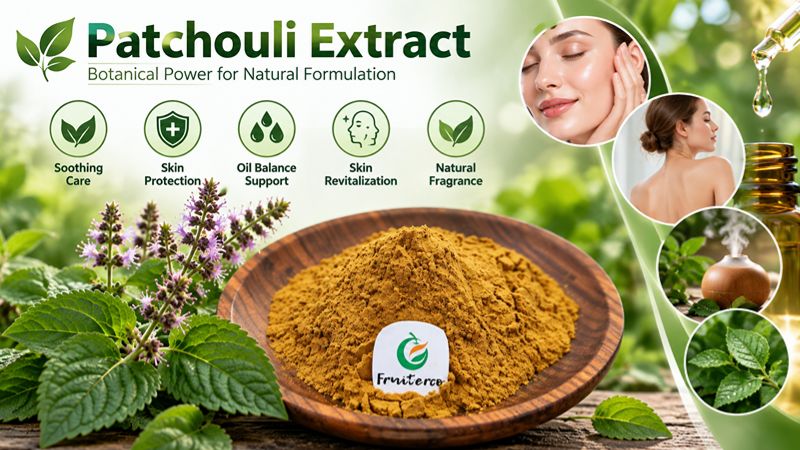
patchouli extract uses:
1. Cosmetics and Personal Care
Patchouli extract can be used as a natural, plant-derived functional ingredient in the development of cosmetic formulations. Potential applications include:
- Face creams and lotions
- Serums
- Body care products
- Shampoos and hair care products
- Bath products
- Handmade soaps
- Natural skincare formulations
- Plant-based care products
2. Fragrances and Aromatics
This is one of the most classic applications for patchouli. Known for its excellent fixative properties and unique woody, spicy profile, patchouli is widely used in perfumes and other fragrance products. Its scent blends harmoniously with a variety of olfactory families, including floral, woody, and oriental notes.
3. Aromatherapy and Scented Products
Patchouli has long been utilized in aromatherapy and the broader fragrance sector. Characterized by a highly distinctive scent, it is used in:
- Aromatherapy products
- Scented candles
- Diffusers
- Fragrance sprays
- Aromatic care products
4. Functional formula based on natural plants
5. Scientific research and natural product development
FAQs:
Q1: Are Patchouli Extract and Patchouli Essential Oil the same?
Not exactly. Patchouli Essential Oil typically refers to the volatile essential oil obtained through methods such as steam distillation, whereas Patchouli Extract has a broader definition, encompassing various types of phytochemicals obtained through different extraction processes. Therefore, when sourcing, one should verify the extraction method, plant part used, solvent system, and key active ingredient specifications.
Q2: What are the main constituents of Patchouli Extract?
Patchouli contains a variety of natural compounds, including patchoulol, pogostone, β-patchoulene, α-bulnesene, and β-caryophyllene, as well as other terpenes, flavonoids, and phytosterols. The specific composition depends on the plant source and the extraction process.
Q3: Can Patchouli Extract be used in cosmetics?
Patchouli-derived ingredients have long been used in perfumes, cosmetics, and personal care products. When incorporating it into specific products, one should verify compliance based on target market regulations, raw material specifications, safety assessments, and the requirements of the final product formulation.
Q4: Can Patchouli Extract be used in perfumes?
Yes. One of the most well-established commercial applications for patchouli is in the fragrance industry. Its warm, woody, and spicy scent makes it suitable for use in perfumes and a wide range of other fragrance products.
Q5: What should be considered when sourcing Patchouli Extract in a B2B context?
- Botanical name
- Plant part used
- Extraction method
- Extraction ratio
- Key active ingredients
- Appearance and odor
- Moisture content
- Microbiological parameters
- Heavy metals and pesticide residues
- Batch-to-batch consistency
- COA and relevant quality documentation
Contact Us:
Fruiterco can provide efficient and convenient delivery methods for the products that customers need. For example: air, sea, express, you can rest assured of product quality problems during transportation.
We have professional business staff to communicate with you about your product needs and understanding. We are a high-quality zinc citrate powder supplier in China.
There is a professional mailbox system, if you want to buy patchouli extract, you can leave a message at any time, we will reply as soon as we see it. Contact us: Email: info@fruiterco.com.
References:
1. Xu F, Cai W, Ma T, et al. Traditional Uses, Phytochemistry, Pharmacology, Quality Control, Industrial Application, Pharmacokinetics and Network Pharmacology of Pogostemon cablin: A Comprehensive Review. The American Journal of Chinese Medicine. 2022;50(3):691-721. DOI: 10.1142/S0192415X22500288.
2. Thakur A. Therapeutic potential of Pogostemon cablin herb: a comprehensive review. Pharmaceutical Patent Analyst. 2022;11(6):213-224. DOI: 10.4155/ppa-2022-0021.
3. Exploring the pharmacological potential and bioactive components of Pogostemon cablin (Blanco) Benth, traditional Chinese medicine. Pharmacological Research - Modern Chinese Medicine. 2024;10:100382. DOI: 10.1016/j.prmcm.2024.100382.
4. Kumar A, Sharma N, Chanotiya CS, Lal RK. The pharmacological potential and the agricultural significance of the aromatic crop Patchouli (Pogostemon cablin Benth.): A review. Ecological Frontiers. 2024;44(6):1109-1118. DOI: 10.1016/j.ecofro.2024.05.008.
5. Bioactive compounds extracted from patchouli via microwave-assisted hydrodistillation: A 36-year bibliometric and systematic review analysis. Phytomedicine Plus. 2024; DOI: 10.1016/j.phyplu.2024.100616.
6. Mo M, Lin W, Ul Haq MZ, et al. Exogenous glutathione (GSH/GSSG) promoted the synthesis of patchoulol and pogostone, main active components of Pogostemon cablin (Patchouli). Industrial Crops and Products. 2024;222:119788. DOI: 10.1016/j.indcrop.2024.119788.
7. Wu YJ, Li SM, Chen CL, et al. Anti-inflammatory activity of Pogostemon cablin: Bioactive components and their modulation of MAPK and NF-κB signaling pathway. Bioorganic Chemistry. 2025;161:108516. DOI: 10.1016/j.bioorg.2025.108516.
8. Unlocking the Therapeutic Potential of Patchouli Leaves: A Comprehensive Review of Phytochemical and Pharmacological Insights. Plants. 2025;14(7):1034. DOI: 10.3390/plants14071034.